The name Kosovo comes from a historic battlefield in 1389. The Serbian term means “Field of the Blackbirds.” For centuries this region served as the medieval center of the Serbian Empire until the decisive Battle of Kosovo led to five hundred years of Ottoman rule.
Kosovo is a landlocked territory and the smallest country in the Balkans. It borders Serbia to the north and east, North Macedonia to the south, Albania to the west and Montenegro to the northwest.
Kosovo declared independence on February 17, 2008, making it one of the world’s newest states. Not all countries recognize Kosovo’s independence; around eighty UN members have not recognized it. In 2010 the International Court of Justice ruled that Kosovo’s declaration of independence did not violate international law, a decision not accepted by Serbia and Russia. Historically, Kosovo was incorporated into Serbia and later became part of Yugoslavia. Throughout the twentieth century the region experienced repeated shifts in autonomy and governance, and by the late twentieth century Muslim ethnic Albanians became the majority. During the breakup of Yugoslavia in the 1990s, tensions escalated between Albanian separatists and Serbian forces, culminating in widespread violence that prompted NATO intervention in 1999.
Today the population is predominantly ethnic Albanian, with a minority of Serbs and smaller communities of Bosnians, Roma and Turks. The official languages are Albanian and Serbian. Most residents are Muslim, while a smaller group follow the Serbian Orthodox tradition.
Kosovo faces significant economic challenges. GDP per capita is low by European standards and unemployment remains high, near 31%. The conflict damaged much of the country’s infrastructure, and recovery has been gradual. Kosovo has a young population—around 26 years on average—which has encouraged emigration. Remittances from the diaspora, particularly from Kosovans living in Germany, Switzerland and Nordic countries, contribute roughly 15% of GDP. The country has mineral resources and is working to expand exports. Energy has been a persistent problem; recent privatization of electricity and international assistance aim to improve power generation and rehabilitate coal plants. Kosovo uses the euro as its official currency, which has helped keep inflation relatively low. The Serbian dinar is still used informally in Serb-majority areas, and informal markets are believed to be significant.
Most Kosovars live in towns and rural areas outside the capital, Pristina, where subsistence farming remains common. Pristina, with a population around 400,000, is the largest city and an emerging European capital with growing cafés and restaurants. Kosovo has several historically important sites tied to the medieval Serbian state, including four Serbian Orthodox churches and monasteries that are recognized by UNESCO. These monuments blend Eastern Orthodox Byzantine and Western Romanesque architectural traditions and preserve an important collection of medieval frescoes.
Kosovars are known for warm hospitality and a lively social culture typical of the Balkans. Visitors often find people eager to help and quick to offer coffee, homemade meals, or even a place to stay. Many Kosovars express gratitude toward international figures who supported their independence, and symbols of the country’s rebirth—like the Newborn monument—are prominent in public life.
Kosovar cuisine reflects Albanian, Turkish and broader Balkan influences. Food varies seasonally: heavier dishes in winter and lighter fare in summer. One iconic dish is flija, a layered pancake-like pie from Albania and popular in Kosovo’s mountainous areas. Flija consists of many thin batter layers cooked one at a time in a special pan, with butter and milk solids added between layers; the lid, called a sac, is heated over a wood fire so the dish cooks from the top down. Other typical dishes include burek (meat, spinach or cheese pies), tave casseroles, stuffed peppers, sarma (stuffed grape or cabbage leaves), kebabs, rice, and a range of breads and dairy products such as yogurt and soft cheeses. Ajvar, a spicy spread made from roasted red peppers and sometimes eggplant, is a ubiquitous table staple, usually served with pickled vegetables. Kosovo’s rivers also supply plenty of trout, which features in local cooking.
Here is a representative Kosovar menu:
The Menu
Starter
Avjar (Roasted Red Pepper Spread)
Served with
Pitalke (Bread from Prizren)
Main Dish
Tave Kosi (Baked Lamb with Rice, Yogurt and Eggs)
Served with
Sallate (Orange, Lemon, Olive and Cheese Salad)
Dessert
Kurore (Honey Dipped Treats)
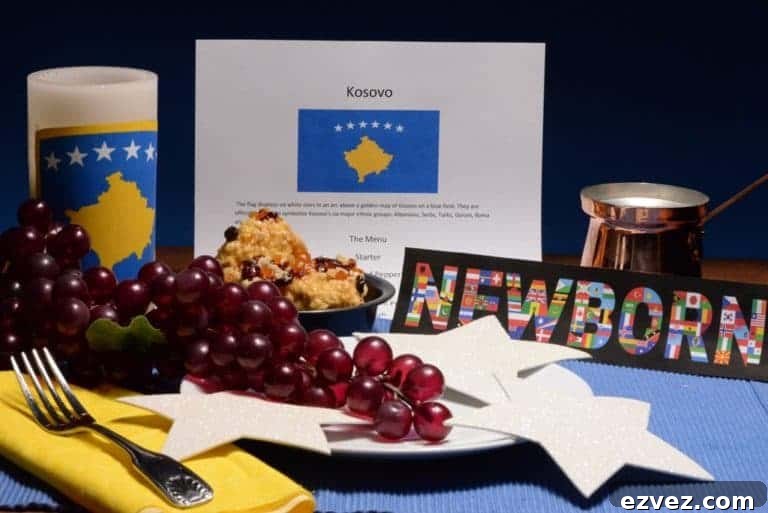
For a themed table we used Kosovo’s blue and yellow colors and displayed symbols like the Newborn monument and the coat of arms. The Newborn sculpture is often repainted to honor nations that recognize Kosovo. We included a ski hat to represent a developing ski resort and a bunch of grapes to celebrate the growing interest in local winemaking.
We began our meal with the Albanian phrase “T’bofte mire,” meaning “Bon appétit.” The starter was ajvar, a smoky roasted red pepper spread typically enjoyed with soft pitalke bread from the Prizren region. The combination of warm bread and ajvar is simple and addictive.
The main course was tave kosi, a baked lamb and rice casserole finished with a yogurt-and-egg custard that creates a light, tangy dish. Fresh oregano and garlic complement the tender meat and creamy topping.
The accompanying salad—one of the highlights—combined orange and lemon slices with hard-boiled egg, white brined cheese, black olives, mint and olive oil. The result balanced sweet, tangy and savory flavors and makes a memorable side dish.
For dessert we served kurore, small pastries dipped in honey and studded with raisins, apricots and nuts. Paired with Turkish tea, they were a satisfying finish to the meal.
As we leave Kosovo in this account, we express hope for recognition, stability and peace for its people.
Until next week,
Warmest regards,
Darlene
P.S. Have you ever tried any of these dishes?